
Air cooling ran out of road. Rack densities went past the point where moving enough air was possible, let alone economic, and liquid took over. That was the right call thermally. It also quietly changed what a leak means.
In an air-cooled hall, a coolant leak happens in a chiller in a plant room. It’s a maintenance problem. In a liquid-cooled rack, coolant runs through a cold plate sitting directly on the processor, through manifolds a few inches from the hardware, and through couplings that get opened and closed by hand while the rack next to them is live.
The fluid has moved from the plant room to the electronics. Everything about the acceptable failure rate follows from that.
Three things that changed
The number of joints went up. A traditional cooling circuit has relatively few mechanical connections. A direct-to-chip loop has one per server at minimum, usually more, multiplied across a hall. Every joint is a potential leak path, and the population of leak paths is now measured in thousands per room.
The tolerable leak rate went down. Coolant escaping as vapour, at a rate too low to see or to leave a mark, will still condense somewhere. When the somewhere is a board, the fact that nobody could see the leak isn’t much comfort.
The components got harder to test. A cold plate is a sealed assembly. A coupling is a mechanism with moving parts, dynamic seals and a valve, and it has to hold in two different states: connected, and disconnected with its valves closed. Most test regimes only ever check one of them.
Where the testing hasn’t kept up
Two habits carried over from an era when they were adequate.
The first is sampling. Testing a proportion of production is a reasonable way to manage risk when the consequence of an escaped defect is proportionate. When one escaped coupling can take out a rack, and when couplings are consumable service items that get swapped repeatedly, a batch defect propagates across a hall before anyone connects the dots.
The second is method resolution. Pressure decay is fast, cheap and genuinely useful for catching gross leaks. It resolves to around 1.0 x 10⁻² mbar·L/s. If your specification is several orders of magnitude tighter than that, the test can’t see the leak you’re worried about. It returns a pass. That pass isn’t evidence of anything except that the leak was too small for the instrument.
This is the gap that “liquid tight” hides. Water has a large molecule and high surface tension and won’t pass through a path that gas moves through easily. A component can be genuinely liquid tight and not gas tight, and in a sealed loop running for years, the difference matters.
What adequate looks like now
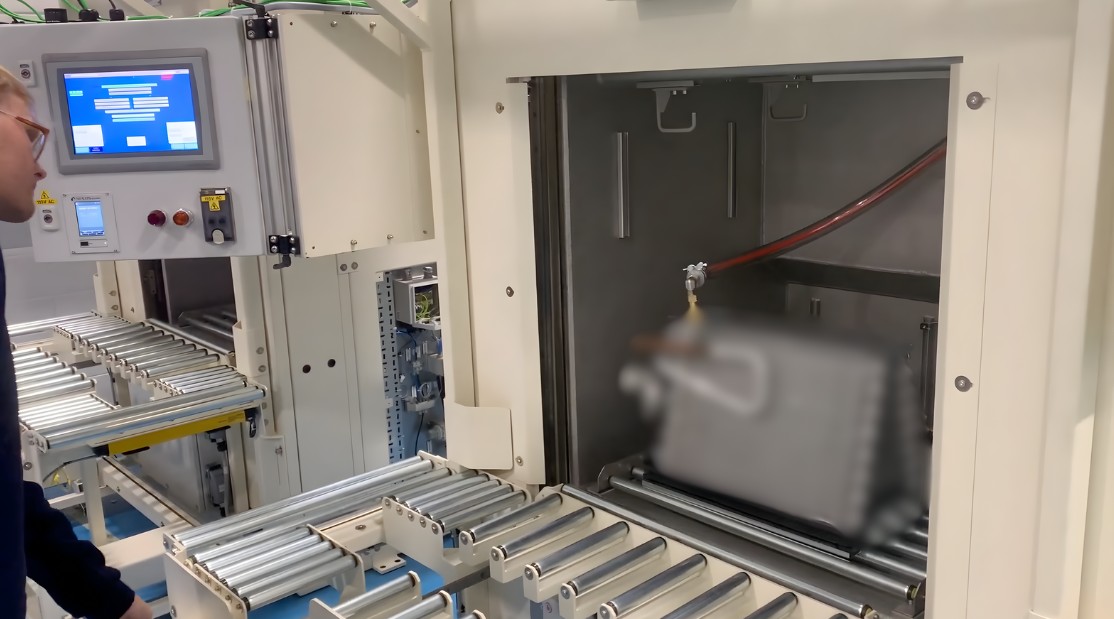
Every unit tested, not a sample. A method that resolves the specified rate with margin and gives a measured leak rate alongside the pass or fail. Both sealed states proven on couplings. A result recorded against every serial number, so that a question raised in two years can be answered with data.
None of that is exotic. Helium vacuum testing has been doing it in automotive and refrigeration production for decades. What’s new is that data centre cooling now needs it, and a lot of the supply chain is still working to specifications and methods inherited from a time when the fluid stayed in the plant room.
If you’re building cold plates, manifolds, CDUs or couplings and your test regime hasn’t been revisited since liquid cooling became the default, it’s worth revisiting now.