Inline coupling leak testing means proving every coupling on the line, at rate, without the test becoming the bottleneck. The laboratory question is whether a coupling is tight. The production question is whether you can prove it on every unit inside your takt, including load and unload.
This piece covers what has to happen inside the cycle, where the time actually goes, and the architectural choices that decide whether a test station keeps up with the line it’s installed on.
What has to happen inside takt
A helium vacuum cycle is a sequence, and each step takes time.
Load and seal the chamber. Evacuate. Charge with helium. Measure the coupling half open. Measure it closed. Reclaim the helium. Vent. Unload.
Every one of those is a candidate for optimisation, and most of them are not where people assume. Evacuation is the step everyone looks at first. In practice, load, seal and unload frequently account for more of the cycle than the measurement does, particularly on a part that needs careful positioning.
That matters because it changes what you should be buying. A faster pump on a station whose real constraint is fixturing buys you very little.
Single chamber against twin chamber
The architectural decision that most affects throughput is how many chambers the station runs.
On a single-chamber station, everything is sequential. The operator loads, the cycle runs, the operator unloads, and nothing else happens in between.
On a twin-chamber station, loading and unloading on one side overlaps with the test cycle on the other. The measurement time hasn’t changed, but the dead time around it largely disappears. The station stops waiting for a person.
Against a single-chamber process, a twin-chamber architecture can achieve a test interval of around 45 seconds and roughly 80 parts per hour, an improvement in the order of 56 to 67 per cent.¹
The other thing twin-chamber architecture buys is a one-operator flow. One person can keep both sides fed, which is often the difference between the test station fitting into an existing cell and needing its own headcount.
Gross leak screening in the same station
A part with an obvious defect will flood a chamber with helium and cost a long recovery before the next test can run.
Screening for gross leaks first, in the same station, protects the cycle time and protects the instrument. It’s a small addition to the sequence that stops one bad part from taking the line down for twenty minutes.
Handling a coupling family without an operator error
Very few manufacturers build one coupling size. The platform has to accept the whole range, and it has to be error-proofed so an operator physically can’t run the wrong programme on the wrong part.
Poka-yoke tooling isn’t a nicety here. On a mixed-size line without it, the question isn’t whether an untested part eventually passes, it’s when.
This is where the bespoke nature of the tooling stops being a constraint and starts being the point. A fixture designed around a coupling family can carry mechanical keying that makes the wrong combination impossible, rather than relying on an operator reading a screen correctly at the end of a shift.
Helium as a consumable
Helium prices have risen 30 to 40 per cent in recent years and supply is volatile.
On a high-volume coupling line, charging and reclaim can be integrated into the test system so the gas is recovered rather than vented. That changes the cost per part rather than the price of the machine, and it’s the figure worth modelling before the capital decision rather than after it.
What good looks like
If you’re specifying an inline coupling leak test system, these are the questions worth asking:
- Does the cycle fit inside your takt, including load and unload, rather than measurement alone?
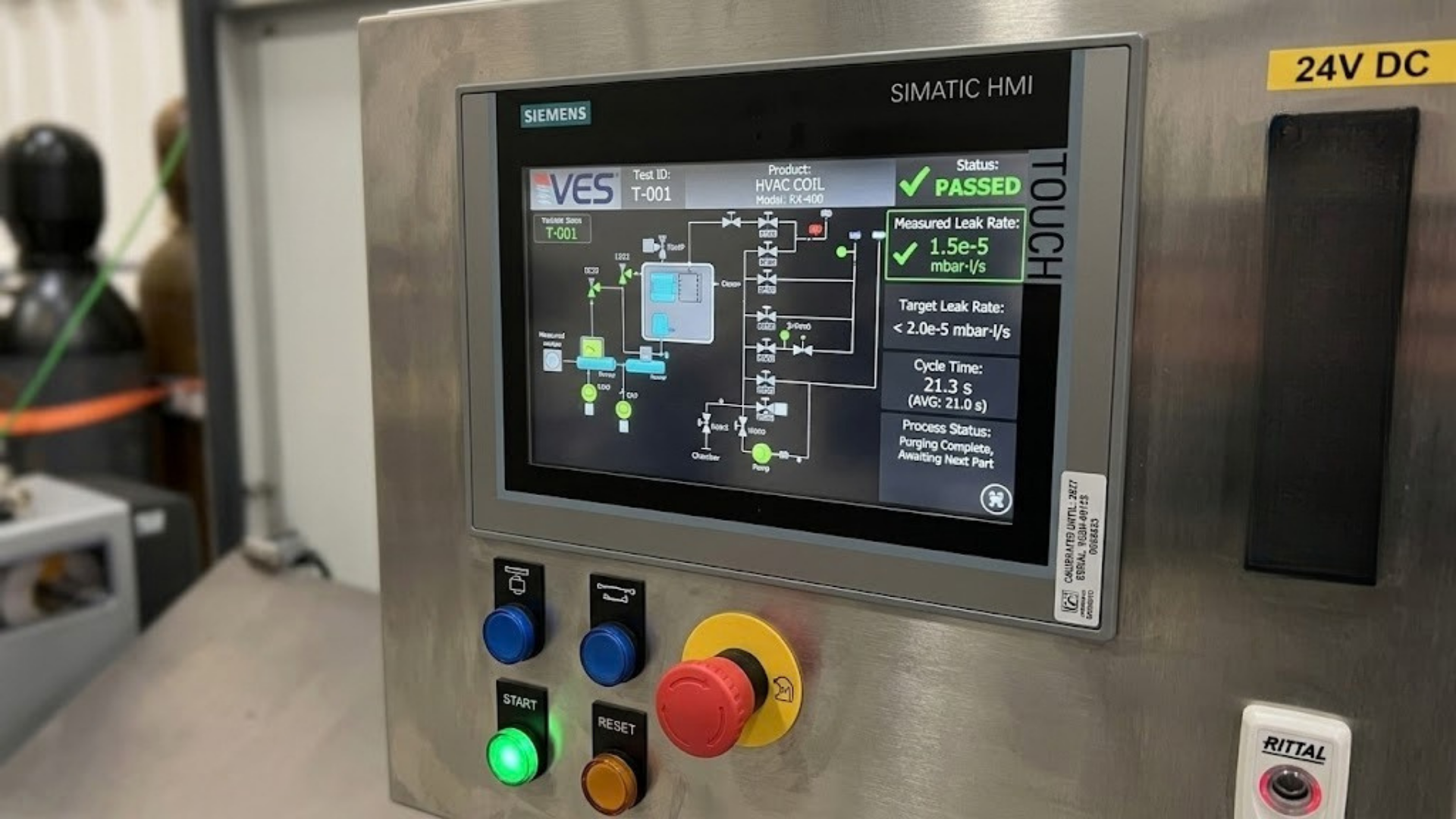
- Does it prove both states, open and closed, with a measured leak rate recorded against each?
- Does it test each half of the coupling in turn, rather than inferring the result from bench checks on sub-components?
- Does it screen for gross leaks before the fine leak test?
- Does the tooling cover your whole coupling family, error-proofed?
- Does it record a result against every serial number?
- Does it recover helium rather than vent it?
- Can it integrate with your line without rewriting machine PLC logic?
Every machine we design and manufacture is built to a CPK of 1.67, so the test itself isn’t the source of variation in your data.
Frequently asked questions
How is a quick disconnect coupling leak tested in production?
One half at a time. A half goes into an evacuated chamber on its own, it’s charged with helium and tested open and then closed, and a measured leak rate is recorded against each state. Within the cycle there are normally two helium tests, low pressure first and then high pressure.
What leak rate can a production helium vacuum test resolve?
On HVAC components our systems take testing to 2.0 x 10⁻⁶ mbar·l/s, with a clear pass-fail result carrying a measured leak rate value. By comparison a pressure decay test resolves to around 1.0 x 10⁻² and accumulation testing to around 1.0 x 10⁻³.
How is cycle time reduced without losing sensitivity?
Mostly by attacking the dead time rather than the measurement. Twin-chamber architecture overlaps load and unload with the test cycle, gross leak screening protects the instrument from long recoveries, and fixturing designed around the part removes manual repositioning.
How are different coupling sizes handled on one platform?
With tooling designed around the family rather than a single part, and with error-proofing that prevents the wrong programme running on the wrong part. Tooling is bespoke to the coupling geometry, so the family has to be understood at the design stage.
How much helium does a coupling line use?
That depends on chamber volume, test pressure and rate. The more useful question is how much of it you get back: charging and reclaim can be integrated so the gas is recovered rather than vented, which changes the cost per part.
¹ These figures are theoretical, based on similar part and process assumptions, with final performance dependent on confirmed product and test requirements.