Leak testing for high-volume cooling components takes more than precision. You can have the most accurate helium leak detector available, but if the test rig slows down your production or can’t handle future product changes, it’s not going to last.
What manufacturers need is a system that moves fast, adapts easily, and stays reliable as your operation grows. That’s exactly what we build at VES. With over 1,600 systems installed worldwide, we’ve helped manufacturers across a range of industries improve throughput, save helium, and prepare for whatever comes next.
Here’s what goes into building a leak test rig that actually works for you, not against you.
Common Problems That Slow You Down
If you’re in high-volume manufacturing, you’re probably dealing with a mix of these issues:
Throughput versus sensitivity
The more sensitive your test, the more time it takes. On a production line, that becomes a bottleneck fast. The key is to eliminate wasted time between tests like pump down and purge cycles without sacrificing accuracy.
Changing product designs
Cooling systems are constantly changing. New layouts, different manifolds, shifting pressure requirements. Your test rig needs to handle all of it without needing a complete rebuild.
Unplanned downtime
When a rig goes offline, so does everything else. A well-designed system makes it easy to service, quick to troubleshoot, and simple to keep running.
Rising helium costs
Helium prices aren’t going down. A good test rig should recover and reuse as much helium as possible. Without recovery, your costs will only climb.
Disconnected systems
Standalone benches aren’t enough anymore. Test equipment needs to integrate with your factory’s automation, from conveyors to robotic handling.
Tough shop floor conditions
Vibration, temperature shifts, contamination and operator variability are all part of real-world testing. Your system should be built to handle it all reliably.
What Makes a Rig Future-Ready
Here’s what we include in every rig to make sure it keeps up with production, even years down the line.
Modular architecture
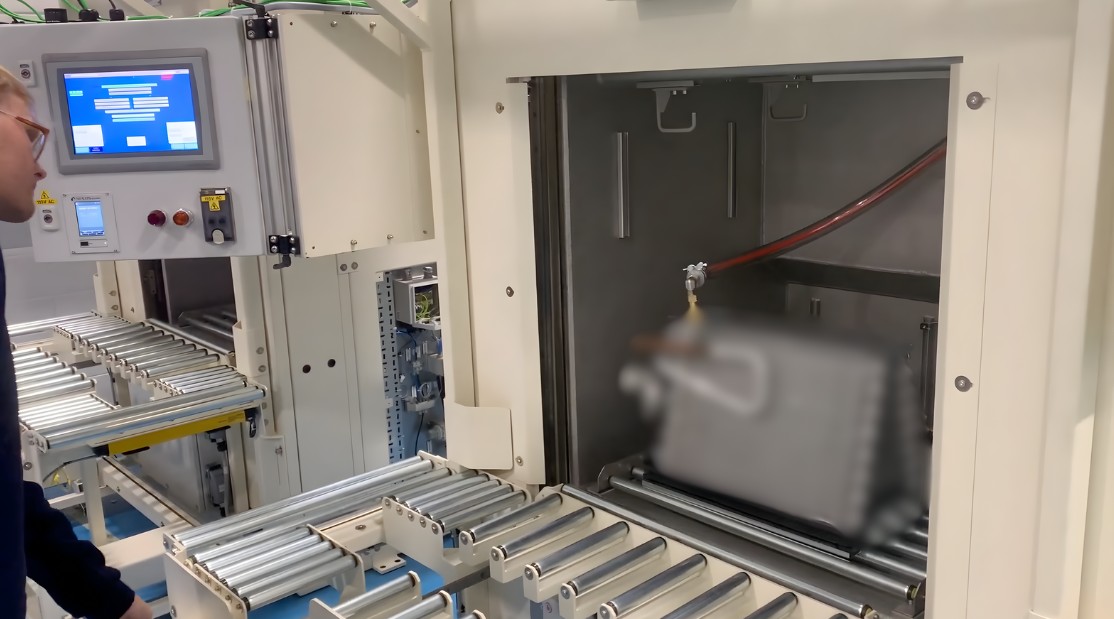
We build using skids and modular sections. That way, you can upgrade, replace, or expand your rig without tearing everything apart. Want to switch out your vacuum pumps or add a new control unit? No problem.
Parallel testing stations
Instead of running one part at a time through a big chamber, multiple test channels let you handle several parts at once. This hides cycle overhead and helps keep your output high.
Fast, staged pumping systems
We use a combination of roughing and high-vacuum pumps to bring parts down to test pressure as quickly as possible. Smart valve sequencing reduces helium loss and gets you to the test faster.
Helium recovery built in
With helium prices increasing, this feature pays for itself. Our systems can recover and purify up to 95% of the helium used in each cycle. That adds up to serious cost savings.
Flexible fixtures
Quick-change tooling and universal interface plates make it easy to switch between part types. No need for time-consuming rework when your product changes.
Live diagnostics and predictive maintenance
Our rigs come equipped with sensors to monitor vacuum levels, pump health, valve cycles and more. You can track performance in real time, identify issues early, and schedule maintenance before anything breaks.
Automation and connectivity
Whether you’re using a PLC, SCADA system or full robotic handling, our rigs integrate easily with your line. Pass/fail signals, data logging and remote access are all built in.
Designed for service
We make sure everything is easy to access. Valves and sensors are hot-swappable where possible, and we include redundant paths in essential systems. You can service the rig without taking the whole thing offline.
Environmental control
To avoid false readings and contamination, we design with tight plumbing, purge options and clean component enclosures. Stability at the baseline is key.
A Smarter Leak Test Cycle
Here’s how a typical cycle flows with one of our systems:
- The part is loaded and sealed
- A rough vacuum is pulled
- The system transitions to fine vacuum and injects helium
- Our mass spectrometer monitors for helium leakage
- Helium is recovered and purified for reuse
- If a leak is detected, sniffing or localisation tools can identify the source
- The system is purged and reset, ready for the next part
Every step is tuned to reduce idle time and use only the helium that’s needed.
Let’s Build Something Better
If you’re dealing with slow tests, high helium bills or equipment that just can’t keep up, it’s time to look at something new.
Our team designs and builds leak test rigs that improve throughput, reduce operating costs and are ready for the future. And we support you every step of the way, from concept to installation and beyond.
Ready to talk?
Contact us today and find out how we can help you build a smarter, faster and more flexible test system.