
AI is changing everything, including how we cool data centres. As processing power ramps up and thermal loads get heavier, traditional cooling just isn’t cutting it anymore. We’re now seeing cooling approaches like liquid immersion, microfluidics, and two-phase systems stepping into the spotlight. They’re more efficient, more compact, and a lot more demanding when it comes to leak integrity.
At VES, we’re seeing more manufacturers look ahead and ask the right questions: How do we test these systems effectively? What’s coming next? And how do we stay ready for it?
Let’s break down where cooling is heading and what that means for the future of leak testing.
The Cooling Trends You Can’t Ignore
Liquid and Direct Liquid Cooling
A growing number of data centres are moving past traditional air cooling and adopting direct liquid cooling. It’s a shift that’s all about getting closer to the heat source, cutting down on airflow constraints and delivering more consistent thermal control.
Cold plate technology is one area evolving fast. Thinner plates, new microchannel designs, smarter materials, all good things, but also more complex to seal. Microsoft’s foray into microfluidic cooling, where coolant channels are etched directly into the silicon substrate, takes things even further. It boosts heat removal by up to three times and slashes peak temperatures by roughly 65%
That kind of performance tells us something important. Cooling is becoming part of the chip itself, not just a support system.
Immersion and Two-Phase Cooling
Immersion cooling is another major leap forward. Whether it’s single-phase or two-phase, fully submerging components in non-conductive fluids allows for complete heat removal.
Microsoft found that switching between cooling methods like air, cold plate, and immersion can reduce greenhouse gases by up to 21% and cut water use in half. That’s huge. But immersion isn’t without its challenges. Even a tiny leak or imperfection can cause serious issues, especially in environments where fluid purity and dielectric stability matter.
So leak testing has to be even more rigorous, even more precise.
Close-Coupled and In-Row Cooling
These systems position cooling units closer to the source, cutting down on air movement inefficiencies. They’re widely used today and serve as a stepping stone to more advanced cooling strategies. For future AI-heavy workloads, they’ll likely sit alongside or be replaced by liquid and immersion options.
The Real Impact on Leak Testing
As cooling systems change, so does the testing that supports them. Here’s what we’re keeping a close eye on:
- Much Tighter Leak Limits
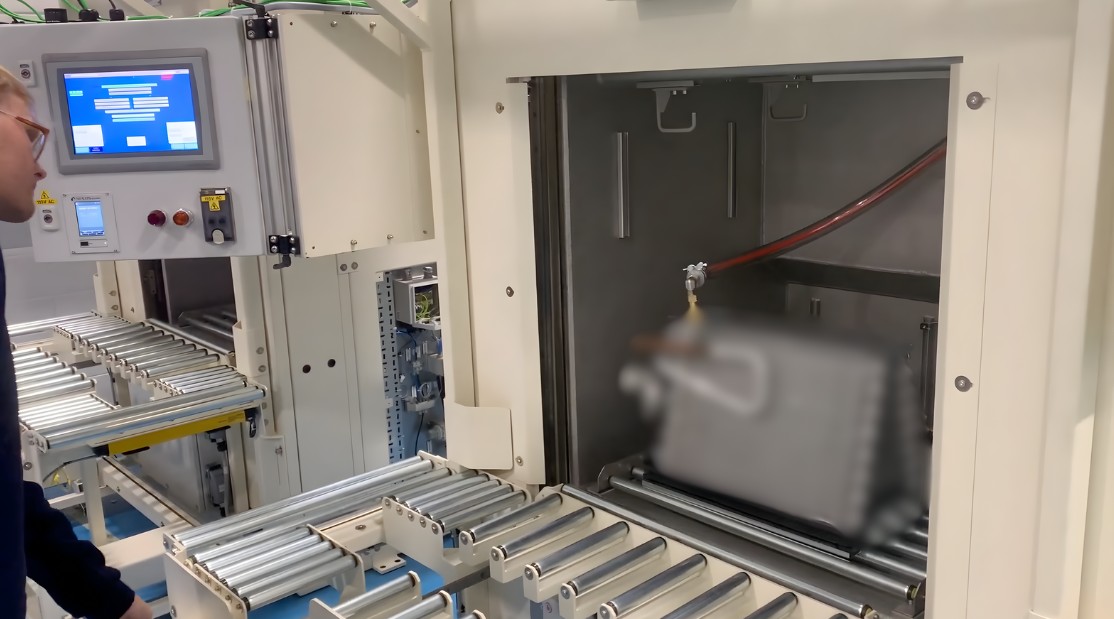
With thermal tolerances shrinking, acceptable leak rates could need to drop to the 10⁻¹² or even 10⁻¹³ mbar·L/s range. Test systems need to detect the smallest leaks reliably and consistently. - Complex, Embedded Channels
Microfluidics and embedded coolant paths mean leaks could be hiding in places probes can’t reach. Fixtures need to evolve to access and validate these intricate paths. - More Parts, Faster Throughput
With higher volumes comes the need for more scalable testing. You’ll need multi-part fixtures, parallel test lanes, and systems designed for high-speed, high-sensitivity operations. - Cleaner Test Environments
The tighter your detection range, the more sensitive your system becomes to background gases. You’ll need clean plumbing, ambient controls, and purification systems that keep the signal clear and consistent. - Helium Recovery and Reuse
Helium isn’t cheap, and it’s not getting cheaper. Reclaiming and reusing test gas through closed-loop systems isn’t just smart, it’s essential. - Smarter, Self-Monitoring Test Systems
Future-ready systems won’t just test parts. They’ll monitor their own health, track performance over time, and flag issues before they cause downtime. - Precision Calibration and Traceability
When testing down to ultra-low leak rates, your calibration equipment needs to be just as accurate. Every result should be traceable, reliable, and repeatable. - Material Compatibility and Ageing
As new fluids hit the market, seals and coatings need to be tested under real-world conditions. Corrosion, ageing, and chemical compatibility all need to be factored in from the start.
Looking Ahead
The future of data centre cooling is exciting, and it’s already arriving. As systems get smaller, faster, and more powerful, the need for airtight leak testing grows right along with them.
Whether it’s immersion, microfluidics or high-density liquid cooling, we’ve built test rigs that are ready for what’s next. And we’re constantly improving to keep pace with where this industry is heading.
Want to make sure your cooling components are leak-free, future-proof and built to last? Get in touch with the team at VES and let’s talk about how we can help.