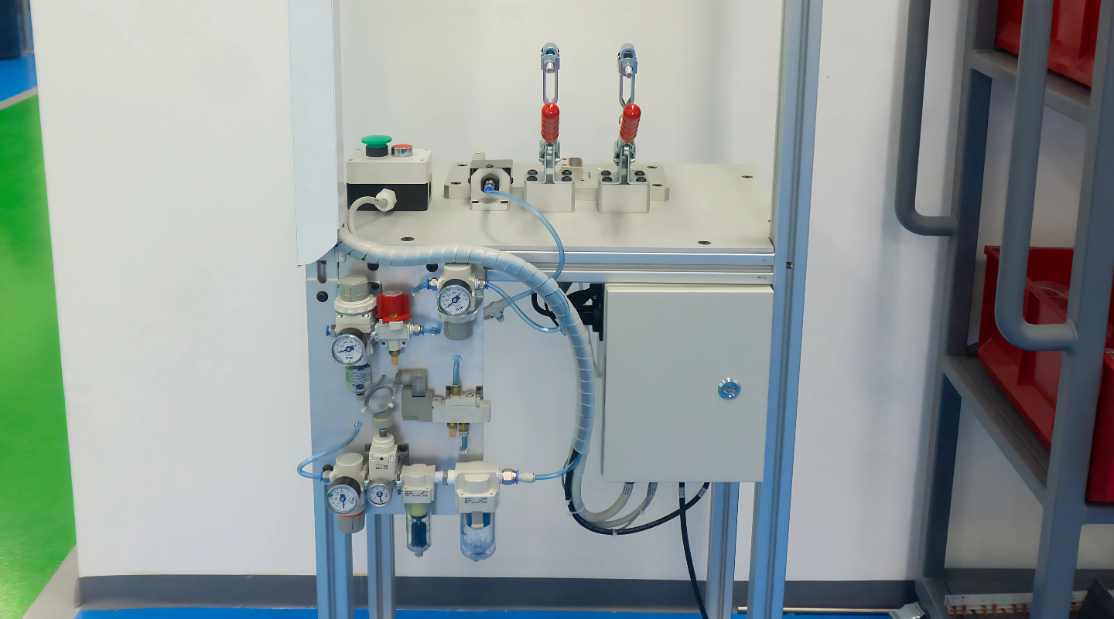
The pressure decay method fills a part with dry air or nitrogen, isolates it from the supply, and measures how far the pressure falls over a set time. A falling pressure means gas is escaping, and the rate of fall indicates the size of the leak. It’s simple, dry and inexpensive, it resolves leaks down to roughly 10⁻² mbar·L/s, and it remains one of the most widely used production leak tests for parts with a moderate specification.
Tracer gas methods such as helium are more sensitive, but pressure decay still earns its place on a production line. This guide covers how it works, where it performs well, where it stops working, and when to move to another method.
What Is the Pressure Decay Method?
Here’s how it works. You pressurise a part using air or an inert gas like nitrogen, seal it off from the pressure source, and then monitor for any drop in pressure over time. If the pressure stays steady, you’re in the clear. But if it drops, that usually means there’s a leak, and how quickly it drops tells you how big the leak might be.
It’s simple, doesn’t need expensive gases, and you don’t need high-end equipment to get started. That’s why many still rely on the Pressure Decay Method for basic leak detection tasks.
Why Choose Pressure Decay?
Easy to Use: It’s a straightforward method. Small footprint, minimal training, and no complicated machinery to worry about.
Budget-Friendly: Because it doesn’t need specialised gear, it’s a great fit for smaller manufacturers or anyone trying to keep testing costs down.
No Mess: Since it’s a dry test, there’s no need to dry components afterwards—unlike methods like bubble testing.
What Are the Limitations?
Now, pressure decay isn’t perfect. There are some trade-offs to be aware of:
- Not Super Sensitive: It’s not great for detecting tiny leaks. Its sensitivity is around 10⁻² mbar·litre/sec, which is fine for many applications, but not for ones needing ultra-precise results.
- Takes Time: You have to let the pressure stabilise before measuring, which slows things down, especially with large components.
- Sensitive to the Environment: Changes in temperature or humidity can throw off results, leading to false readings.
- No Leak Location Info: It tells you there is a leak, but not where it is.
- Volume Changes Can Affect Accuracy: Pressurising a part can slightly change its shape or volume, which might impact the results.
- Slower Throughputs: Particularly with bigger parts, the process can drag a bit.
Vacuum decay works on the opposite principle, evacuating the part and watching for a rise, and it suits some parts better because it’s less affected by temperature. Read how the vacuum decay leak test works, or see vacuum decay vs pressure decay compared side by side.
When’s the Best Time to Use It?
Pressure decay is perfect when you’re testing a high number of parts with moderate leak rate requirements. Think automotive parts like intake manifolds or fluid reservoirs, HVAC components, or even certain consumer or medical products.
It’s also a smart move as a first step in leak testing. By spotting any obvious leaks early, you avoid wasting expensive tracer gases like helium. That’s a big win if you’re trying to keep things running smoothly and cost-effectively.
For general checks, say, testing valves, seals, or housings, it does the job well. But if you’re dealing with more sensitive components like hydrogen fuel systems or sterile medical gear, then you’ll want something like helium vacuum chamber testing for that finer level of detail.
Getting More from What You’ve Got
Pressure decay is evolving, too. New digital sensors and control systems are helping improve its accuracy and automation potential. So, if you’ve already got a pressure decay setup, it might be worth looking into retrofits. You can increase performance and keep up with tighter industry standards without needing a full equipment overhaul.
Picking the Right Method
Leak testing isn’t one-size-fits-all. The best method depends on what you’re testing, how precise you need to be, and how fast you need the results. Pressure Decay Method is still a great choice when you want a balance between cost, ease, and efficiency.
Whether you’re running a small test station or a full-scale production line, we’re here to help you decide if pressure decay is the right fit, or if it’s time to explore another method.