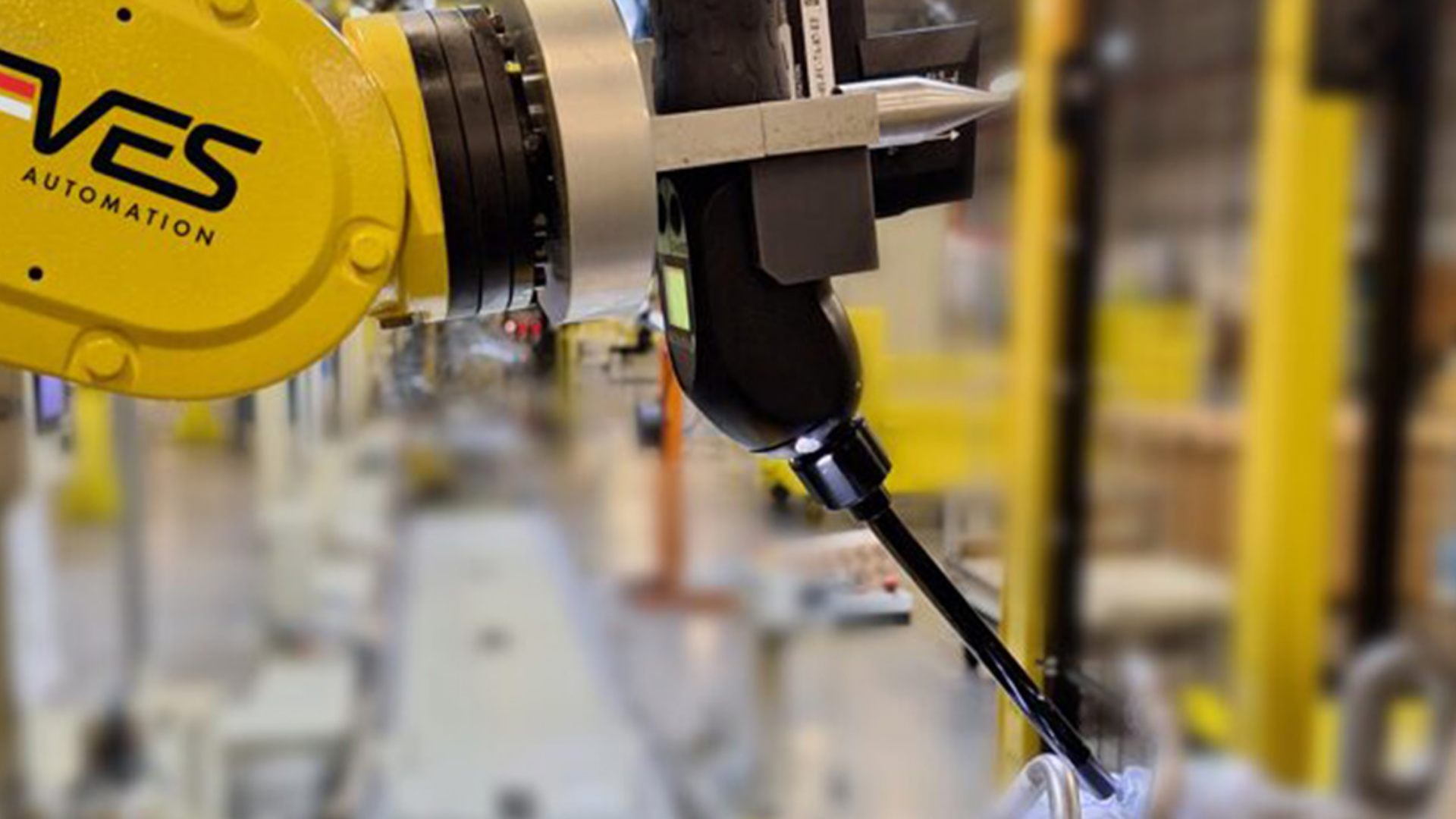
Helium sniffer leak testing uses helium as a tracer gas and a probe to detect helium escaping from a component or assembly. It is a useful method when the aim is to locate a leak, check accessible areas or support rework and diagnosis.
Like every leak testing method, sniffer testing is not the right answer for every production requirement. It can be highly useful in the right application, but it may not provide the same repeatability, automation potential or pass/fail control as a well-designed chamber-based system.
VES design helium leak testing systems around the part, required leak rate, cycle time and production process. For the main helium systems page, see helium leak testing systems.
What Is Helium Sniffer Leak Testing?
In a helium sniffer leak test, a part is charged with helium or a helium mix. A sniffer probe is then moved around likely leak points, joints, welds, seals or accessible surfaces. If helium escapes from the part, the probe detects it.
This makes sniffer testing valuable when the location of the leak matters. It can help production or quality teams understand where a component is failing, rather than only confirming that it has failed.
How a Helium Sniffer Leak Test Works
A typical helium sniffer process includes:
- Charging the part with helium or a helium mix.
- Moving the probe around suspected leak areas.
- Detecting escaping helium at the surface.
- Identifying the leak location for rework or investigation.
- Recording or confirming the result as required.
The sensitivity and reliability of the test depend on the detector, probe handling, test pressure, helium concentration, access to the leak path and the skill or consistency of the operator.
When Sniffer Leak Testing Is Useful
Sniffer testing is useful when the test needs to find where a leak is located. This can make it valuable for:
- Rework and fault finding.
- Development and prototype work.
- Checking joints, welds and accessible seals.
- Large or complex parts that are difficult to chamber.
- Lower-volume testing where manual inspection is acceptable.
- Confirming suspected leak paths.
For HVAC manufacturers, sniffer testing may be useful on accessible joints or assemblies where pinpointing a leak is more important than high-speed automated pass/fail testing.
When Sniffer Testing May Not Be the Best Choice
Sniffer testing may not be the best method where the production process needs high-speed, repeatable and operator-independent pass/fail testing.
Potential limitations include:
- Operator technique can affect the result.
- Probe speed and distance from the leak matter.
- Access may be limited on some products.
- Background helium can influence measurement.
- It may be slower than automated chamber testing.
- It may not be ideal for very small leak rates in high-volume production.
This does not make sniffer testing a poor method. It means it should be specified for the right job.
Sniffer Testing vs Hard Vacuum and Accumulation Testing
Hard vacuum helium testing is often used where high sensitivity and repeatable pass/fail production testing are required. The part is usually placed in a chamber, making the method less dependent on manual probe movement.
Accumulation testing can be useful where chamber testing is not practical or where the required sensitivity supports an atmospheric approach. Escaping tracer gas is collected and measured over time.
Sniffer testing is strongest when leak location matters. It can also be combined with other methods, for example using chamber testing for production pass/fail and sniffer testing for diagnosis of failed parts.
Production Risks: Operator Dependency, Access and Repeatability
In production, repeatability is critical. A test result should reflect the product, not variation in operator movement, probe angle or test setup.
Manufacturers considering sniffer testing should review:
- Required leak rate.
- Operator access to likely leak areas.
- Probe speed and positioning.
- Test pressure and helium concentration.
- Background helium control.
- Data capture needs.
- Whether automation or robotic probing is required.
VES can help assess whether sniffer testing is suitable or whether hard vacuum, accumulation or another method would provide better production confidence.
HVAC and Industrial Examples
Sniffer testing can be useful across HVAC, automotive, clean energy and industrial applications where leak location is important. It may be used on air conditioning assemblies, pipework, joints, manifolds, pressure components or larger assemblies where chamber testing is not practical.
For broader HVAC sector guidance, see HVAC leak testing systems.
Choosing the Right Helium Leak Testing Method
The right method depends on the part, leak rate, production volume and whether the process needs to locate leaks or confirm leak-tightness. VES can specify manual, semi-automated or fully automated helium leak testing systems around the application.
If helium use is significant, VES can also advise whether PURE helium recovery could support the process. See PURE helium recovery systems.
Speak to VES About Leak Testing Methods
Ask VES to review your part, leak rate requirement and production process to confirm whether sniffer testing, hard vacuum testing, accumulation testing or a combined method is most suitable.